

For years FIFA has been selling the 2026 World Cup as the biggest, boldest and most “inclusive” tournament ever staged. Bigger draw. More teams. More cities. More sponsors. More spectacle. More everything. That, in itself, should have been the warning. When football’s governing body starts boasting about scale before substance, it usually means the soul of the thing has already been sold off in instalments.
And here we are, only weeks out, staring at what is shaping up to be the most grotesquely commercialised, politically compromised and spiritually hollow World Cup in living memory.
Not the best. Not the boldest. Not the most global. The worst.
A World Cup in a country that still does not understand football
The central absurdity remains the same as it was the day the hosting rights were awarded: the United States is not a football nation.
It is a sports-entertainment nation. A branding nation. A television nation. A nation that can package anything, inflate everything and market mediocrity as destiny. But football is still, at best, a tolerated foreign language there. The game exists, obviously. It has fans, money, infrastructure and enough celebrity attachment to fill endless puff pieces. But none of that changes the deeper reality. This is a country where the domestic league still functions largely as a retirement lounge, a content machine and a soft-power accessory for investors.
Yes, MLS has had Beckham. Yes, it has had Messi. Yes, it has poured fortunes into academies, franchises and image management. And still, to the rest of the footballing planet, it remains a sideshow. A league people notice when a fading superstar arrives, not when the football itself speaks.
That matters. World Cups are not just logistical exercises. They need atmosphere, memory, football culture, a sense that the event has landed in a place where the game means something beyond hospitality packages and drone shots. The United States can stage a Super Bowl, a WrestleMania, a military flyover, a billionaire convention. That is not the same thing.
Canada and Mexico, meanwhile, are dragged into this circus as co-hosts, expected to smile for the brochure while the bulk of the tournament bends to US political and commercial logic. Canada gets the sanitised reputation boost. Mexico brings the actual footballing pulse. Both are effectively along for the ride while Washington and FIFA hog the wheel.

Infantino’s masterpiece of servility
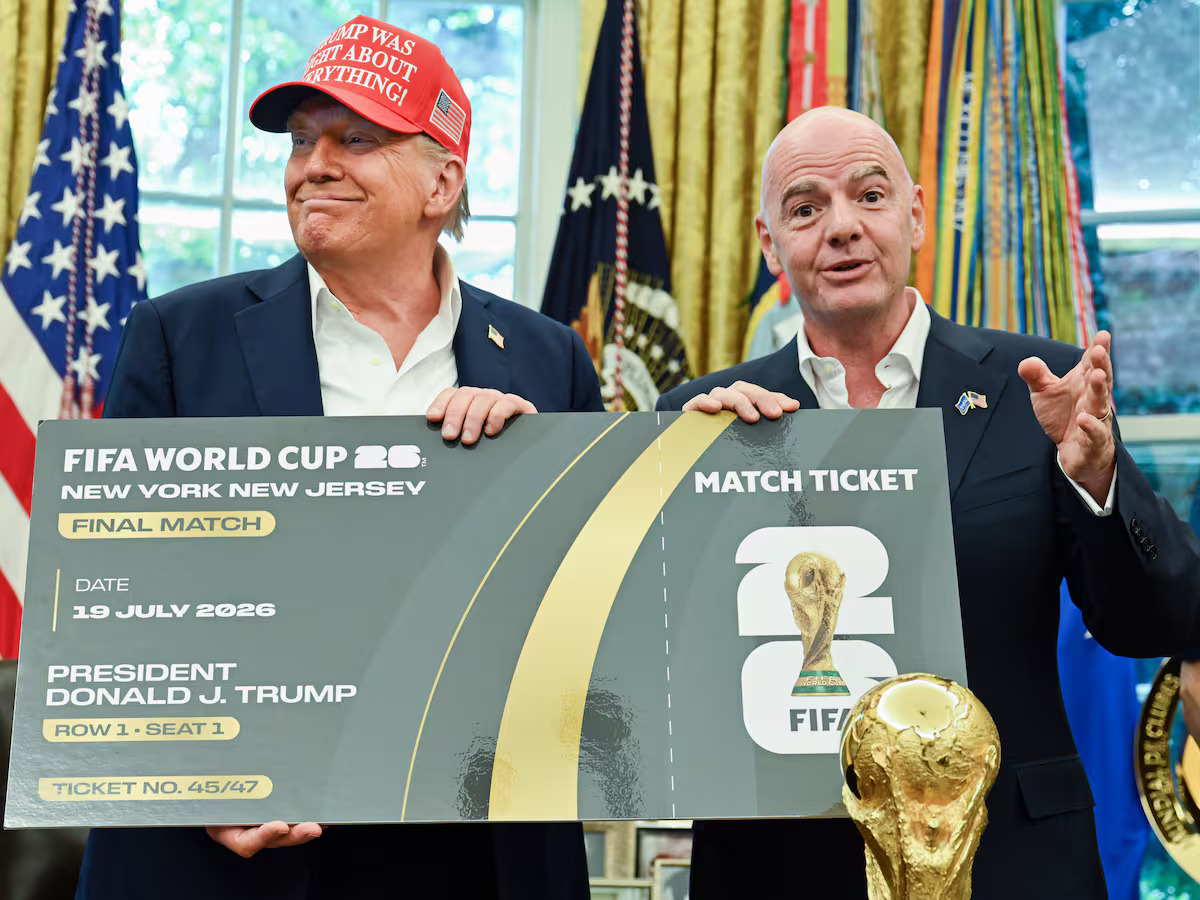
If anyone still needed proof that FIFA under Gianni Infantino has become a travelling court of flattery and self-parody, they got it in December, when Donald Trump was handed the inaugural “FIFA Peace Prize – Football Unites the World” during the World Cup final draw in Washington.
You could hardly invent a more perfect symbol of what this tournament has become. A made-up award. A grovelling FIFA president. A narcissistic host president being massaged in public like a Roman emperor at a second-rate banquet.
Infantino has always had the air of a man who would clap for his own reflection if he thought it might secure another private jet. But even by his standards, this was spectacularly infantile. A football tournament has not even started, and its governing body is already kneeling before power in the most embarrassing way possible.
Trump will not host the tournament. He will infest it
One of the worst things about this World Cup is that the football will have to compete every single day with Donald Trump’s ego.
No one seriously believes he will remain in the background. He will try to dominate the event rhetorically, politically and symbolically. He will tweet through it, grandstand through it, insult people through it and hijack headlines after practically every major match. The tournament will be treated not as a celebration of world football but as another stage for American presidential theatre.
That would already be exhausting. Under Trump, it becomes dangerous too.
Millions of fans heading to the 2026 World Cup face major human-rights risks, and the tournament is drifting far from the “safe, free and inclusive” event FIFA once promised. The fears are obvious: mass deportations, aggressive immigration enforcement, restrictions on protest and the real possibility that supporters find themselves attending a World Cup in fear of arbitrary arrest, deportation or intimidation.
That alone should have been enough to trigger a political earthquake inside FIFA. Instead, we get silence, PR sludge and more photographs of Infantino hovering near Trump like an overexcited maître d’.
Trump will not merely host this World Cup. He will contaminate it.
No one seriously believes he will keep to the background. He has already lashed out repeatedly at foreign leaders, including Pedro Sánchez, over Spain’s refusal to fall into line behind US militarism, and Macron has publicly expressed solidarity with Madrid in response to Trump’s threats. In that context, the idea that major leaders will happily stroll into the presidential box beside him for photo opportunities feels, at the very least, doubtful. Even where attendance is not formally ruled out, the political toxicity is obvious. This is supposed to be a World Cup, not a forced parade of diplomatic humiliation.

Borders, bans and bonds
The most obscene contradiction of all is this: FIFA keeps talking about a global festival, while the United States keeps making it harder for large parts of the globe to attend.
Four qualified countries, Haiti, Iran, Ivory Coast and Senegal, fall under Trump-era travel restrictions, meaning fans from those nations cannot attend matches hosted in the United States.
Then there is the visa bond lunacy. The US has expanded a policy requiring some visitors to post bonds of up to US$15,000, supposedly to deter overstays. Fans from countries such as Cape Verde could be hit by exactly this requirement if they wanted to attend matches in the US.
So let us call things by their proper names. FIFA wants to sell this as the most inclusive World Cup ever, while one of its hosts is effectively telling sections of the football world: you can come if you are rich enough, politically convenient enough, and sufficiently docile at the border.
What kind of World Cup is that?

Iran is not a footnote. It is a warning
The tournament’s geopolitical instability is no longer theoretical.
Iran has already said it would boycott matches in the United States on safety grounds, while leaving open the possibility of playing in Canada or Mexico if FIFA rescheduled those fixtures.
That matters well beyond one team. Iran is not some minor novelty act. It is one of Asia’s serious football nations and a regular World Cup participant. If a major side is openly questioning whether it can safely play in part of the host country, then the tournament is already compromised before a ball is kicked.
And that is the point. This World Cup is being pitched as a frictionless mega-event while the real world keeps barging in through the front door. Wars, travel bans, retaliatory politics, militarised borders, collapsing diplomatic norms. FIFA keeps pretending football floats above all of it. It does not. It never has.
Bigger tournament, thinner tournament
FIFA’s other great sales pitch was expansion. Forty-eight teams. One hundred and four matches. The biggest World Cup ever.
But bigger is not automatically better. Often it is just bloated.
One of the old virtues of the World Cup group stage was its density. There was jeopardy early. There were collisions between heavyweights before the tournament settled into routine. Even when smaller nations appeared, they did so in a tighter field that gave every match more consequence. The expanded format dilutes that. It multiplies fixtures while reducing concentration. It creates more content, more travel, more dead space, more chances for mismatches that do little for the tournament’s dramatic core.
With all due respect to emerging football nations, a group-stage schedule packed with fixtures that lack historical weight, elite talent or broad followings simply does not hit the same. A Brazil-Croatia, Spain-Netherlands or England-Italy (all examples of 2014 group-stage matches) carries memory, ghosts, edge and audience. A tournament overloaded with lower-stakes pairings may be more inclusive on paper, but it is less magnetic in practice.
That is not snobbery. It is how sporting drama works.

The fan experience has already been poisoned
Even if you put aside the politics, the basic supporter experience has already been turned into a racket.
European fan groups have filed a formal complaint over FIFA’s World Cup ticketing, accusing it of abusing its monopoly, inflating prices through dynamic pricing, lacking transparency over seat allocation and using bait advertising. US lawmakers have also criticised FIFA’s use of dynamic pricing, warning that it would make this the most financially exclusionary World Cup to date.
Then came New Jersey’s now infamous transit fare. Fans travelling to MetLife Stadium for World Cup matches, including the final, could be charged US$150 for a return public-transport journey, a tenfold jump from the usual fare. Even FIFA admitted the hike could have a “chilling effect”.
Pause for a second and appreciate the full idiocy of it. Tickets already cost a fortune. Hospitality is everywhere. Fans are being milked by resellers. And then, on top of that, one of the showcase venues wants to sting people US$150 just to move them from New York to the stadium and back.
This is not football. It is extraction.
The market has started to smell the problem too. Hotels in several host cities have been slashing room rates because ticket prices, inflation fears and anti-American sentiment were prompting supporters to scale back travel.
So much for the unstoppable demand story. Turns out supporters do notice when they are being treated like a wallet with legs.
Security, fear and the American backdrop
No serious person needs lecturing on what worries many foreign supporters about the United States. Mass shootings. Political extremism. Racism. Hyper-militarised policing. A culture of casual violence that much of the outside world finds deranged. Add a World Cup to that mix, with huge crowds, nationalist emotion and an administration obsessed with crackdown politics, and the result is not reassuring.
Intelligence briefings have already warned of potential extremist attacks, risks to transport infrastructure and civil unrest linked to Trump’s immigration crackdown, all while security funding arguments drag on.
Again, this is not random internet panic. The risks are real enough that organisers and governments are arguing publicly over who pays, who protects and who takes the blame when things go wrong.
Mexico and Canada deserve better than this
Mexico should be hosting a World Cup on its own terms, not helping launder the image of a tournament whose centre of gravity lies in the United States. It has football heritage, emotional investment and a genuine street-level relationship with the game. Instead it gets dragged into a three-country mega-format designed primarily for corporate volume.
Canada is suffering a different kind of indignity: being told to play the polite junior partner while access problems are already showing at the margins.
This supposedly borderless global celebration is already being shaped by who gets admitted, who gets excluded and who gets quietly told that, regrettably, the welcome mat has conditions attached.

And from a pure football perspective? It is thinner than people admit
Even if you strip away every political, moral and logistical objection, this World Cup is still less alluring on the pitch than several of its predecessors.
Italy, one of the great historical powers of the tournament, have failed to qualify yet again. Not once, not twice, but for a third consecutive World Cup, a collapse so severe it has triggered another full-blown crisis in Italian football. For a competition already struggling for aura, losing a nation of that weight matters. It matters historically, emotionally and commercially. A World Cup without Italy is not automatically a bad World Cup, but three in a row is a sign that something in the tournament’s familiar architecture has been lost.
The old rivalry map looks weaker too. Messi and Cristiano Ronaldo, the two players who have dominated global football attention for the best part of twenty years, arrive in the twilight rather than the blaze of their careers. Germany is no longer the fearsome machine it once was. Brazil and Argentina still carry weight, but not quite the same mythic inevitability. And several classic European match-ups do not feel as combustible as they did in the past.
Part of that is cyclical decline. Part of it is the bloated format. And part of it is something more intangible but still real: in a number of European national sides, the old sense of uniform national identity, the chest-out, anthem-bellowing, trench-war symbolism that once gave certain fixtures their savage emotional edge, has faded. That is not a moral complaint and it is certainly not a racial one. It is a cultural observation. Some teams simply do not project the same singular national myth they once did, and some rivalries therefore feel less like continental collisions and more like high-end fixtures in an overfamiliar globalised football marketplace.
And from the football side alone, the tournament is already diminished. Italy are out again. Russia were not even allowed into qualification, while Israel were. Messi and Cristiano are approaching what is almost certainly the last major tournament of their careers not as its central suns, but as fading constellations. The old heavyweight map is less imposing, the rivalries less charged, the group stage less concentrated, the atmosphere more diluted. This World Cup does not feel like the summit of an era. It feels like the overextended, overmarketed afterparty.

The worst World Cup in history?
That verdict sounds excessive only if you focus on the poster and ignore the substance.
A host nation that still treats football as a market segment. A co-hosting model that leaves Mexico and Canada cleaning up someone else’s mess. An expanded format that prioritises quantity over intensity. Trump looming over the whole event like a malfunctioning loudspeaker. ICE fears. Travel restrictions. Visa bonds. Security warnings. Ticket-price gouging. Transport extortion. Hotel volatility. A FIFA president grovelling before power and handing out fake peace prizes like a school principal who has lost his mind.
Put all of that together and the conclusion becomes hard to avoid.
The 2026 World Cup is not shaping up to be a celebration of football. It is shaping up to be a case study in how to drain the joy, dignity and universality out of the biggest tournament on earth, while still insisting everyone clap for the branding.
FIFA wanted the biggest World Cup ever.
It may yet get the most disgraced one instead.
Deja una respuesta