

There are lies. There are historical distortions. And then there is the Western version of the Second World War: a glossy Hollywood theme park in which the United States lands in Normandy, says something noble through clenched teeth, raises a flag, kisses a nurse, and saves civilisation before the credits roll.
Very moving. Also, absolute garbage.
The war against Nazi Germany was won, above all, on the Eastern Front. It was won at Moscow, Stalingrad, Kursk, Leningrad, Sevastopol, Minsk, Warsaw, Budapest, Vienna and Berlin. It was won by Soviet soldiers, Soviet workers, Soviet women, Soviet partisans, Soviet engineers, Soviet railway crews, Soviet peasants, Soviet factory hands, Soviet children growing up under siege and bombardment. It was won by a civilisation that absorbed the full force of the Nazi war machine and broke it.
And the West has never forgiven them for it.
There is a phrase widely attributed to Marshal Georgy Zhukov: “We liberated Europe from fascism, but they will never forgive us for it.” Whether perfectly sourced or not, the sentence survives because it contains a political truth so obvious that even a European Parliament resolution cannot quite bury it under its usual compost heap of liberal hypocrisy.
The Soviet Union did not merely “contribute” to victory. It carried the central burden of the war in Europe. The Red Army destroyed hundreds of Axis divisions and inflicted the overwhelming majority of German military losses. Even after D-Day, there were still more German forces fighting in the East than in the West. This is not Soviet nostalgia. This is basic arithmetic, that terrible enemy of propaganda.

The Soviet price was almost beyond language. More than 27 million Soviet citizens died. Whole regions were turned into wasteland. Cities were starved, burned, flattened, occupied and then rebuilt. The Soviet Union lost not only soldiers, but civilians by the million: workers, Jews, Ukrainians, Russians, Belarusians, Kazakhs, Armenians, Georgians, Tatars, people from every republic of the Union. It was a multinational sacrifice on a scale the comfortable West still refuses to understand.
This was not an abstract national tragedy. Across the former Soviet republics, family memory of the war is not distant history; it is a grandfather who never came home, a grandmother who survived hunger, a village emptied, a city rebuilt from ash. In much of the former USSR, the Great Patriotic War still lives inside family albums and cemetery visits. Almost every family has a name, a wound, a silence. That is why Western revisionism is not just academically dishonest. It is obscene. It spits on the dead and then calls itself European memory.
Yet look at the memory game.
In France in May 1945, when people still had the smoke of war in their lungs, 57% said the USSR had contributed most to Germany’s defeat. The United States came far behind at 20%. By 1994, the answer had flipped: 49% said the United States, only 25% said the USSR. By 2004, the United States had climbed even higher. Memory did not evolve. It was manufactured. It was processed, packaged, exported and sold back to Europe like a Coca-Cola advert with tanks.
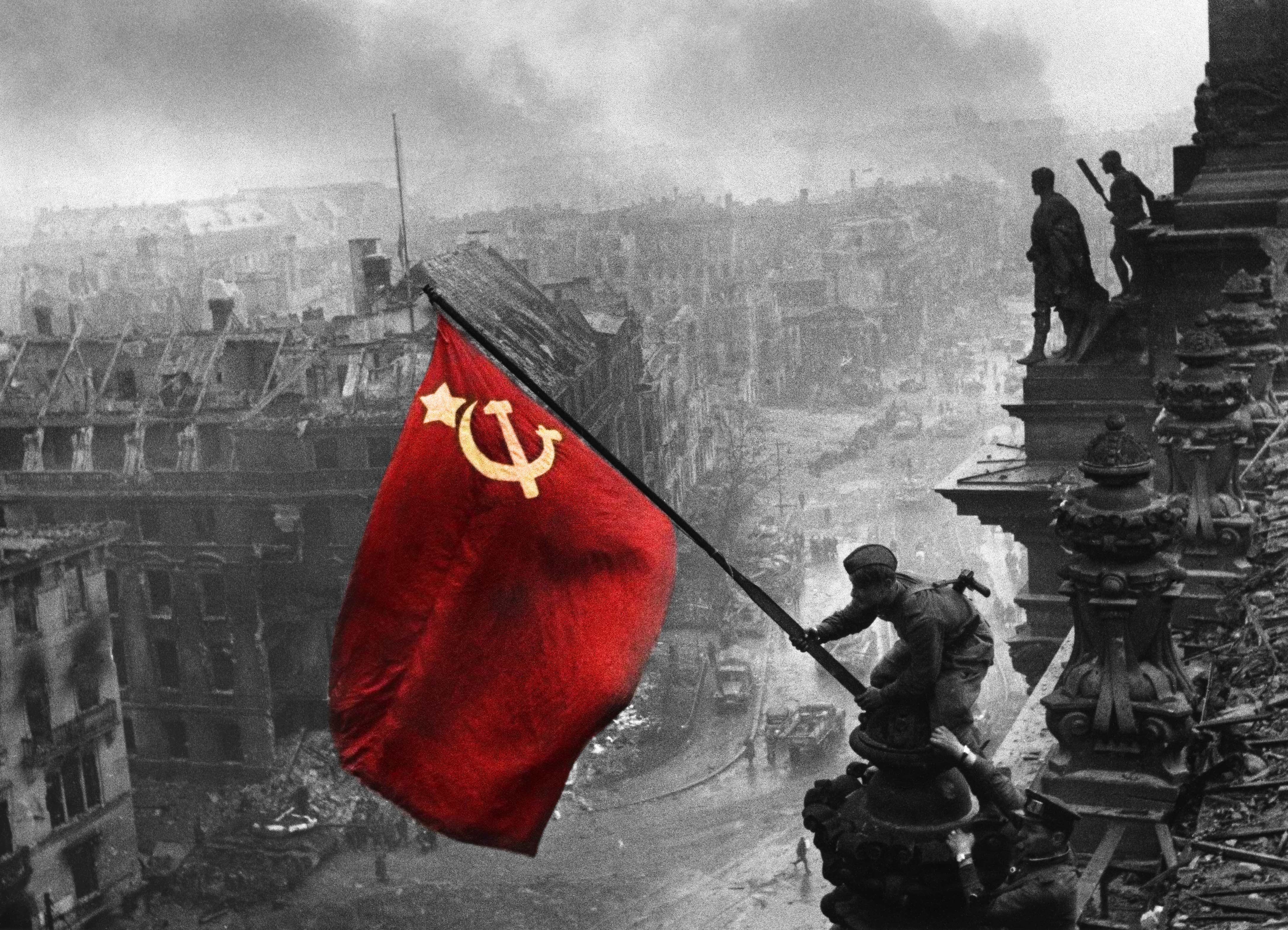
This is what cultural power does. It does not need to ban history. It drowns it in cinema, textbooks, commemorations, headlines, video games and official ceremonies where everyone looks very solemn while carefully avoiding the inconvenient red flag over the Reichstag.
Hollywood did not invent the erasure, but it industrialised it. For generations, young people have been taught, directly or indirectly, that WWII was won by American courage, British resolve and a few anonymous “Russians” somewhere in the snow. The Soviet soldier appears, when he appears at all, as brutal, faceless, Asiatic, dangerous. The Nazi is often humanised. The communist is rarely allowed to be human. There is the real ideological obscenity.

And there is another detail the West often treats as decorative: the Red Army liberated Auschwitz. It liberated Majdanek before that, the first major Nazi camp to be reached by Allied forces, and later liberated camps including Gross-Rosen, Sachsenhausen, Ravensbrück, Stutthof and Theresienstadt. The soldiers who opened the gates of Auschwitz on 27 January 1945 were not extras in an American film. They were Soviet soldiers. The moral image of the liberation of Europe from Nazism cannot be separated from that fact, however much Western memory managers keep trying to crop the photograph.
And then comes the European Union, draped in blue, yellow stars and moral superiority, celebrating “Europe” and “freedom” while treating the Soviet victory like an embarrassing relative at a wedding. The same European institutions that claim to defend historical memory have promoted resolutions equating Nazism and communism, as if the force that raised the victory banner over Berlin can be casually placed in the same moral box as the regime it destroyed.
How convenient. How European. How utterly shameless.
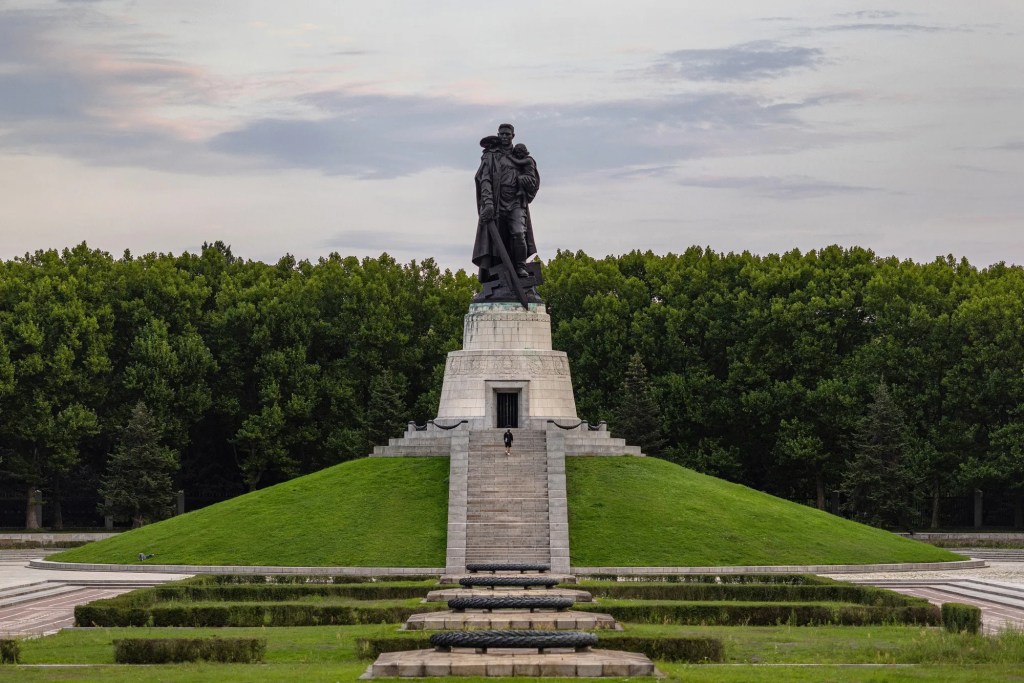
That is why the current assault on Soviet war memorials across parts of Eastern Europe is so vile. Streets, parks, monuments and memorials once dedicated to the Soviet soldiers who died defeating Nazism have been renamed, removed or left to decay under the respectable language of “decommunisation”. But tearing down the memory of the Red Army does not cleanse history. It dirties it. You do not have to support the current Russian government to recognise that Soviet soldiers died defeating Hitler. Only a historically diseased political culture confuses today’s geopolitical alignment with the right to vandalise yesterday’s dead.
This is the political sewer in which figures like Kaja Kallas and Volodymyr Zelensky operate. Kallas’s government openly drove the removal of Soviet war monuments in Estonia, including the Narva T-34 memorial, presenting memorials to Red Army soldiers as security threats or symbols of occupation rather than as monuments to the army that helped destroy Nazism. The Estonian government itself described the policy as the removal of “Soviet Union war monuments” from public space. Zelensky, meanwhile, has treated the cult of Stepan Bandera with grotesque indulgence. In 2019 he said that Bandera being a hero for some Ukrainians was “normal and cool”, while adding that too many streets and bridges should not carry the same name. This is how fascist memory is laundered in the twenty-first century: not always with swastikas, but with flags, plaques, street names, diplomatic euphemisms and leaders who pretend that Nazi collaboration becomes acceptable if you wrap it in enough anti-Russian nationalism.
And no, this does not mean every Ukrainian, Estonian, Latvian or Lithuanian was a Nazi collaborator. That would be stupid. Many people in those countries resisted fascism, fought in the Red Army, sheltered the persecuted, or suffered under occupation. But it is equally obscene to pretend that collaborationist formations, auxiliary police units and nationalist militias did not help hunt Jews, communists, Roma, partisans and Soviet civilians. In Ukraine and the Baltic states, as elsewhere in occupied Europe, some local collaborators became active participants in Nazi violence. Today’s rehabilitation of those currents, whether through Bandera cults, Waffen-SS veteran marches, street renamings or the demolition of Soviet liberation monuments, is not “national memory”. It is anti-communist revisionism with a fresh coat of EU paint.
None of this means that history should be reduced to saints and icons. The Soviet state made mistakes. Stalin made grave errors, including the catastrophic underestimation of the timing and force of the Nazi invasion. The early months of Operation Barbarossa were disastrous. The Red Army paid horribly for strategic failures, purges, misjudgements and chaos. But history is not a liberal dinner party where complexity is only allowed when it protects Western innocence.
Stalin’s role in the war was immense. He was not a decorative figure on a poster. He was supreme commander, head of the State Defence Committee, the political centre of mobilisation, the man who oversaw the transformation of the Soviet Union into a total war machine capable of moving industry eastwards, absorbing invasion, rebuilding command structures and coordinating the final destruction of Nazi Germany. Historians can and should argue over his decisions. But to deny his centrality to victory is childish. Under his leadership, the USSR survived the Nazi onslaught and ended the war in Berlin.
That is why the hatred is so intense.

Russophobia did not begin in 2022. It did not begin with Putin. It did not even begin with the Soviet Union. Western Europe has feared Russia for centuries: the vast eastern landmass, the “unknown giant”, the empire outside the polite club, too big to ignore, too different to absorb, too stubborn to command. Then came 1917, and Russia became something worse than foreign. It became revolutionary. It became proof that capitalism was not eternal. That is the unforgivable sin.
The West could tolerate a Russian empire as a backward curiosity. It could never forgive a socialist superpower that defeated fascism, industrialised at terrifying speed, educated millions, sent the first human being into space and offered colonised peoples another pole of power in a world otherwise owned by banks, empires and gunboats.
This is why the Soviet victory had to be rewritten. Not because it was unclear, but because it was too clear.
And the erasure does not stop in Europe. China’s role in the world anti-fascist struggle is also routinely pushed to the margins. China fought Japan for years before the war became “world history” in the Western classroom. Chinese casualties were catastrophic. The Chinese front tied down Japanese forces and formed a central theatre of resistance against fascist militarism in Asia. Yet in the Western imagination, the Pacific War is mostly Pearl Harbor, island-hopping, Iwo Jima and the atomic bomb. China becomes background scenery in its own tragedy.
Then there is Japan.
The official American fairy tale says the atomic bombs ended the war and saved lives. Case closed. Back to the barbecue. But history is messier and far more obscene. The Soviet Union declared war on Japan on 8 August 1945 and launched a massive invasion of Japanese-occupied Manchuria the following day. More than one million Soviet troops smashed into the Kwantung Army, destroying Japan’s last serious hope of using Moscow as a mediator for better surrender terms. That Soviet entry was a major factor in Japan’s decision to surrender, alongside Hiroshima and Nagasaki.
And yes, the United States knew what was coming. It knew the Soviets were about to enter the war against Japan. It knew that once they did, the post-war balance in Asia could change dramatically. The atomic bomb was not only a weapon against Japan. It was also a message to Moscow. A mushroom cloud as diplomatic punctuation. The first act of the Cold War, written in civilian ash.
But this too must be softened, because the West likes its atrocities wrapped in necessity and its enemies wrapped in pathology.
The truth is simpler.
The Soviet Union saved Europe from Nazism. China helped bleed Japanese militarism white. The peoples of the socialist and colonised world paid in blood while the future managers of Western memory prepared the museum labels.

Today, young Europeans are taught to fear communism more than fascism, to see the Red Army as occupation before liberation, to treat the hammer and sickle as more offensive than the rehabilitation of Nazi collaborators in parts of Eastern Europe. This is not ignorance. It is political education. It is anti-communist discipline. It is capitalism teaching its children whom to hate.
So when the EU celebrates victory while hiding the Soviet centre of that victory, we should call it what it is: historical theft.
Not forgetfulness. Theft.
The Soviet peoples did not die so Brussels could turn their sacrifice into a neutral “European remembrance” ceremony with the communists airbrushed out and the Americans moved into the starring role. They did not die so schoolchildren could learn history from Netflix, NATO press releases and video games where every Russian accent signals menace.
They died fighting fascism.
They won.
And no amount of liberal varnish, Hollywood mythology, parliamentary revisionism or Cold War poison can erase the fact that when the Nazi beast was finally cornered in its lair, the soldiers who raised the banner over Berlin came from the Soviet Union.
Spasibo, tovarishchi.
History remembers, even when the West lies.
Слава Красной Армии — освободительнице. Вечная память павшим. Вечная слава победителям.
Glory to the Red Army, the liberator. Eternal memory to the fallen. Eternal glory to the victors.
Deja una respuesta